
27 September 2026 · 2 min read
When AI Makes the Hard Part Feel Easy
A useful way to test an AI tool is to give it something you have already decided would be too much trouble.
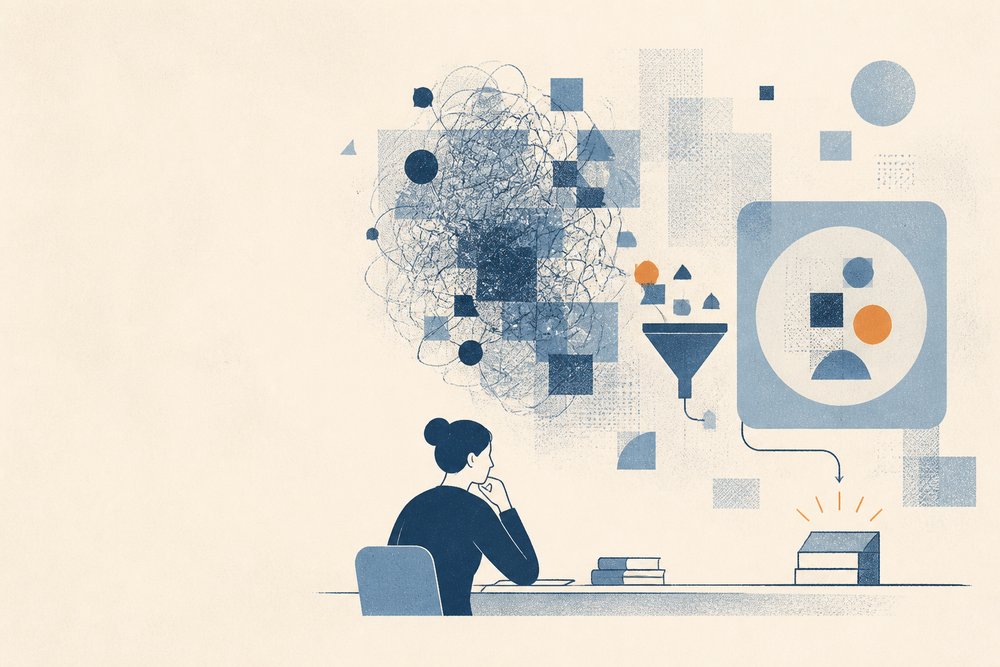
A useful way to test an AI tool is to give it something you have already decided would be too much trouble.
Perhaps it is a small interactive environment, a website that needs rebuilding, or a collection of learning materials waiting to be assembled inside an LMS. The interesting moment arrives when the result is useful enough that your next question changes. Instead of asking how to finish this one task, you start wondering what else you have been ruling out.
That shift is about more than a better answer. In experiments with Astra, a request for a cyberpunk scene led to work inside Blender. A course-building workflow produced its own learning environment before being redirected towards packaging existing materials for Canvas. The surprise was how little of the expected repair work remained after the import.
Those outcomes deserve different kinds of scrutiny. A successful course import tells you something about the packaging. It does not establish whether students will learn, whether the assessment is appropriate or whether the sequence works in a classroom. The useful response is to recognise the time saved and decide where checking matters next.
Explorable environments introduce a similar distinction. A reconstruction of the Library of Alexandria can become somewhere to walk, read and investigate. Its educational value need not depend on treating every detail as historically settled. Students could examine what is supported by evidence, what has been inferred and what was added to make the environment function. They could also build a small part themselves and justify their decisions.
World-building tools make that line of questioning particularly interesting. Taking a generated environment into a game engine can produce a space that someone can walk through. Turning that space into a worthwhile learning experience still requires decisions about what learners should notice, attempt and understand. Subject experts need to examine what the environment gets wrong before an attractive prototype becomes a trusted teaching resource.
Even an unusual experiment such as a browser game informed by fruit-fly neural wiring offers a way into these questions. What comes from the connection data? What comes from the model’s sensory and movement rules? What would its behaviour actually tell us about the biological system it represents?
The excitement and discomfort come from the same place: the distance between an idea and an impressive output feels smaller. Moving across websites, course materials, 3D environments and music projects can unsettle assumptions that one isolated demonstration would leave intact.
There is a risk of mistaking this new ability to produce for mastery. An output can look convincing in an area where its maker lacks the knowledge to evaluate it. There is also a risk of ignoring useful possibilities because an earlier attempt was frustrating.
Neither risk requires a verdict on artificial general intelligence. A more immediate approach is to revisit an assumption, try a bounded task and inspect the result carefully. The question is what becomes possible—and what judgement is needed to make it worthwhile.
To find out more, watch or listen to Episode 30 of Adjunct Intelligence, where Dale Leszczynski and Nick McIntosh explore Astra, Fable 5.1, world models and the experiments that brought back the “wow” feeling.